Cigar Sizes & Shapes Guide
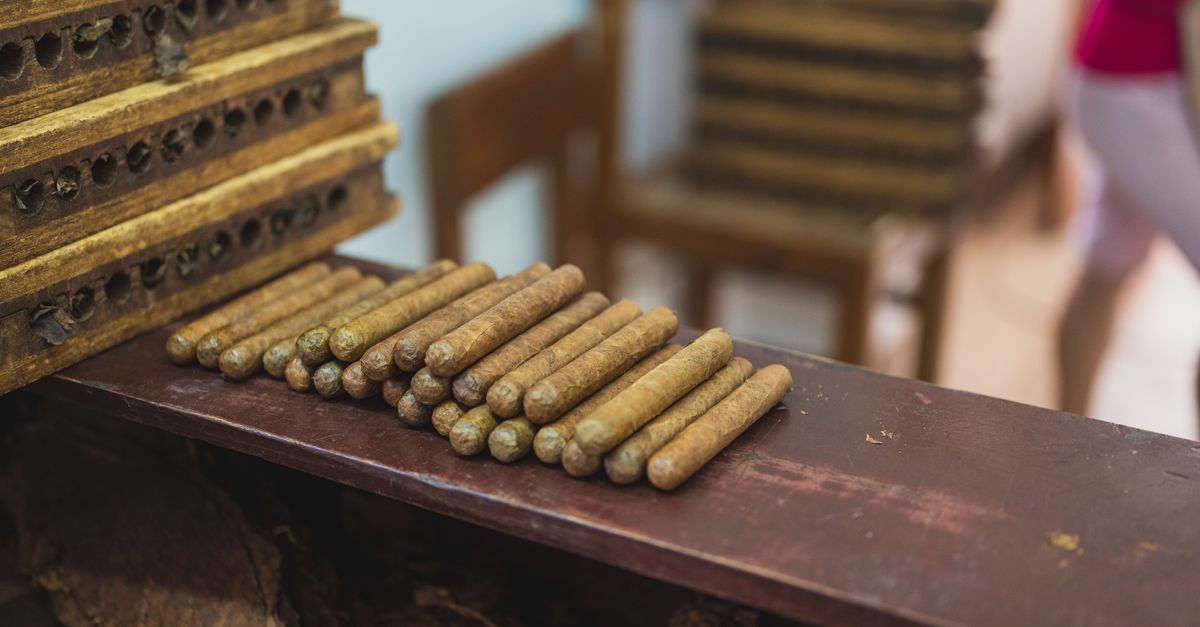
Cigar size comes down to two numbers: length in inches and ring gauge, or diameter measured in 64ths of an inch. For example, a 5 x 50 Robusto is 5 inches long and 50/64 of an inch thick. Size affects both how long a cigar lasts and how intense it feels, so choosing the right one can make a real difference.
This guide breaks down the most common cigar sizes, explains ring gauge, and helps beginners decide where to start.
Named cigar shapes are known as vitolas. Below, you'll find a chart of the most common vitolas, along with figurados, cigars with tapered or pointed ends.
How cigar sizes are measured
Cigar sizes are measured by length in inches and ring gauge, written as length x ring gauge. The first number is the cigar's length, and the second is its diameter in 64ths of an inch. So a 6 x 52 cigar is 6 inches long and 52/64 of an inch across — a touch thicker than half an inch.
Two numbers, two effects:
- Length mainly drives smoke time. A longer cigar simply takes longer to finish.
- Ring gauge drives the ratio of filler to wrapper. Thicker cigars hold more filler, which can mean a cooler, smoother, often fuller smoke.
Once you can read "5 x 50," every cigar sizes chart becomes easy to follow. The names are just shorthand for common length-and-gauge combinations.
What is ring gauge?
Ring gauge is a cigar's diameter expressed in 64ths of an inch. A ring gauge of 50 means the cigar is 50/64 of an inch thick, and a 64 ring gauge is a full inch across. The higher the number, the fatter the cigar.
Ring gauge affects more than looks:
- Filler-to-wrapper ratio: Thicker cigars have more filler relative to wrapper, often giving a smoother, cooler smoke.
- Burn temperature: Wider cigars tend to burn a little cooler, which some smokers find mellower.
- Comfort and pairing: Very thick "gordo" sizes feel big in the mouth; thin ones are crisp and quick.
In recent years thicker ring gauges (54–60) have grown popular, but classic sizes still sit near 42–52. Neither is "better" — it is a matter of taste and time. For the fuller case for each side of that trade-off, see our thick vs thin cigars guide.
Ring Gauge to mm and Inches: Quick Conversion Chart
A cigar ring gauge converts to inches by dividing the gauge number by 64, and to millimeters by multiplying that result by 25.4. For example, a 50 ring gauge equals 50/64 of an inch (0.781 inches), which works out to 19.8 millimeters. The table below lists the exact conversions across common commercial ring gauges.
| Ring gauge | Diameter (inches) | Diameter (mm) |
|---|---|---|
| 38 | 0.594 | 15.1 |
| 40 | 0.625 | 15.9 |
| 42 | 0.656 | 16.7 |
| 44 | 0.688 | 17.5 |
| 46 | 0.719 | 18.3 |
| 48 | 0.750 | 19.1 |
| 50 | 0.781 | 19.8 |
| 52 | 0.813 | 20.6 |
| 54 | 0.844 | 21.4 |
| 56 | 0.875 | 22.2 |
| 58 | 0.906 | 23.0 |
| 60 | 0.938 | 23.8 |
| 64 | 1.000 | 25.4 |
Cigar dimensions usually appear as length by diameter, such as 5 x 50 or 6 x 60. The first number gives the length in inches and the second gives the ring gauge. A 5 x 50 format is five inches long with a 50 ring gauge (19.8 mm), which represents the classic Robusto size. A 6 x 50 cigar adds an inch of length at the same thickness, typical of a standard Toro. Moving to a 6 x 60 delivers a Gordo measuring 23.8 mm in diameter. Massive sizes like an 8 x 80 (measuring 1.25 inches or 31.8 mm across) exist as specialty novelty sticks, but production vitolas rarely exceed 60 to 64. Our breakdown of thick vs thin cigars covers how these diameter shifts affect airflow and wrapper-to-filler ratios.
Cigar sizes chart
The chart below lists the most common cigar sizes by typical dimensions and smoke time, in both inches and metric (cm x mm), since ring gauge and length are traditionally sold in inches but most of the world reads cigars in centimeters and millimeters. Dimensions vary slightly by brand, so treat these as the standard ranges. Use it to match a size to how much time you have.
| Size (vitola) | Typical dimensions (in) | Metric (cm x mm) | Approx. smoke time |
|---|---|---|---|
| Petit Corona | 4.5 x 42 | 11.4 cm x 16.7 mm | 20–30 min |
| Rothschild | 4.5 x 50 | 11.4 cm x 19.8 mm | 30–40 min |
| Robusto | 5 x 50 | 12.7 cm x 19.8 mm | 30–45 min |
| Corona | 5.5 x 42 | 14.0 cm x 16.7 mm | 30–45 min |
| Toro | 6 x 50 | 15.2 cm x 19.8 mm | 45–60 min |
| Panatela | 6.5 x 38 | 16.5 cm x 15.1 mm | 40–55 min |
| Lonsdale | 6.5 x 42 | 16.5 cm x 16.7 mm | 50–65 min |
| Churchill | 7 x 48 | 17.8 cm x 19.1 mm | 60–75 min |
| Lancero | 7.5 x 38 | 19.1 cm x 15.1 mm | 45–60 min |
| Double Corona | 7.5 x 49 | 19.1 cm x 19.4 mm | 90–120 min |
| Gordo / Gigante | 6 x 60 | 15.2 cm x 23.8 mm | 60–90 min |
Smoke times are rough — pace, draw, and how slowly you puff all change the clock. A thinner Lancero burns faster per inch than a fat Gordo of similar length. To convert any size yourself: multiply length in inches by 2.54 for centimeters, and divide the ring gauge by 64 and multiply by 25.4 for millimeters.
Common parejo (straight) sizes
Parejo cigars are the classic straight-sided shapes with a rounded cap, and they include most everyday sizes. These are the cigars most people picture: even cylinders that are simple to cut and light. The Robusto, Toro, and Churchill are the three you will see most often.
Here is what defines the staples:
- Robusto (~5 x 50): The most popular size worldwide. Short, satisfying, full flavor in under an hour. A Cohiba Robusto is a classic example.
- Toro (~6 x 50): A bit longer than a Robusto for a fuller session without going huge.
- Churchill (~7 x 48): A long, elegant cigar named for Winston Churchill; a relaxed hour-plus smoke. A Padrón Churchill shows the style well. See the cigars Churchill and other famous smokers chose.
- Corona (~5.5 x 42): A slim traditional size that highlights the wrapper and blend.
- Lancero (~7.5 x 38): Long and thin, prized by enthusiasts for concentrated flavor.
Most cigar lines offer several of these so you can pick by how much time you have. Explore named examples in our Padrón brand guide.
Beyond the big three, four more parejo names show up constantly on size charts:
- Rothschild (~4.5 x 50): A short, thick cousin of the Robusto — same wide ring gauge in a compact 30–40 minute window.
- Panatela (~6.5 x 38): Long and slim, closer to a Lancero than a Corona; the narrow ring gauge makes the wrapper's flavor stand out.
- Lonsdale (~6.5 x 42): A classic middle ground between a Corona and a Churchill — slim but long enough for a full hour.
- Double Corona (~7.5 x 49): One of the largest standard parejos, often 90 minutes or more; reserve it for an evening with nowhere to be.
Figurado (shaped) cigars
Figurado cigars have tapered, pointed, or bulging shapes instead of a straight cylinder. The taper changes how smoke concentrates as it travels, which can sharpen or shift the flavor compared with a straight parejo. They are more difficult to roll, so they often command a premium.
The main figurado shapes are:
- Torpedo: Straight sides with a tapered, pointed cap that focuses the smoke.
- Belicoso: Similar to a Torpedo but shorter, with a more rounded tapered head.
- Perfecto: Tapered at both ends, bulging in the middle like a classic "cigar" silhouette.
- Pyramid: A wide foot narrowing steadily to a pointed cap.
Figurados can be a fun step up once you are comfortable. The pointed cap usually calls for a precise cut — see our guide on how to cut a cigar.
How size affects your smoke
Cigar size affects both how long you smoke and how the cigar feels. Length largely sets the time, while ring gauge influences the smoothness, temperature, and intensity of each puff. Matching size to your schedule and mood is half the fun of choosing a cigar.
Quick guidance by situation:
- Short on time? Reach for a Petit Corona or Robusto for a 20–45 minute smoke.
- A relaxed evening? A Toro or Churchill stretches to an hour or more.
- Want fuller, cooler smoke? A wider ring gauge often delivers it.
- Want crisp, wrapper-forward flavor? A slimmer Corona or Lancero shines.
There is no universally best size. The right one is the one that fits your time, your taste, and the occasion. If you're weighing a specific length trade-off rather than a named vitola, our long vs short cigars guide breaks down exactly what changes as a cigar stretches out.
Robusto vs Toro: Which Should You Choose?
Robusto vs Toro is the most common size comparison smokers make. Both share the same 50 ring gauge, so the draw width and filler-to-wrapper ratio are identical. The one difference is length — and what that inch means in practice.
A Robusto (5 x 50) is the world's most popular cigar size because it delivers full flavor in 30–45 minutes. That window suits a quick after-dinner smoke, a coffee break, or any session where you need to finish before dark. You get the complete flavor arc of a quality blend without committing to an hour.
A Toro (6 x 50) adds roughly an inch, which adds 15–20 minutes and a longer flavor arc. Complex blends built for gradual development across thirds show more of their depth in a Toro because there is more tobacco to transition through. Most premium brands offer both sizes — try the Robusto of a new cigar first, then move up to the Toro once you know you like the blend.
| Dimension | Robusto | Toro |
|---|---|---|
| Typical dimensions | 5 x 50 | 6 x 50 |
| Ring gauge | 50 | 50 |
| Smoke time | 30–45 minutes | 45–60 minutes |
| Draw character | Same ring gauge — identical draw width | Same ring gauge — identical draw width |
| Flavor development | Full flavor, shorter arc | Same profile, longer arc with more transitions |
| Best for | Quick sessions, 30–45 min windows | Relaxed evenings, 45–60 min windows |
| Beginner-friendly | Yes — short commitment, easy to finish | Yes — just plan for extra time |
The verdict: Choose a Robusto when your window is 45 minutes or less, or when you are trying a new blend for the first time. Choose a Toro when you have the time to let the cigar develop and want to taste how it evolves across its full length. Either size works well as a starting point — see our best cigars for beginners guide for Robusto picks across every strength level. For a deeper dive into this exact matchup, including construction and pricing differences by brand, see our full Toro vs Robusto comparison.
Robusto vs Corona: Same Time, Very Different Feel
Robusto vs Corona surprises smokers who expect two similar cigars — they are roughly the same length but smoke quite differently. The key is ring gauge: a Robusto is 50 and a Corona is 42. That 8-point gap changes the entire character of the smoke.
The Robusto's wider ring gauge produces a higher filler-to-wrapper ratio. More filler typically gives a smoother, cooler, often fuller smoke. The Corona's slimmer profile is more wrapper-forward — the outer leaf contributes more of what you taste, so the difference between a Connecticut and a Habano wrapper is sharper and more immediate. Corona also burns a little hotter and requires a slightly more even light to stay consistent.
| Dimension | Robusto | Corona |
|---|---|---|
| Typical dimensions | 5 x 50 | 5.5 x 42 |
| Ring gauge | 50 — thick | 42 — slim |
| Smoke time | 30–45 minutes | 30–45 minutes |
| Draw | Wide and easy | Narrower and tighter |
| Flavor character | Filler-dominant — smoother, fuller | Wrapper-forward — crisper, brighter |
| Burn behavior | Forgiving, stays lit easily | More sensitive — benefits from a careful light |
| Best for | Smooth, cool, easy smoke | Wrapper-forward experience |
The verdict: Choose a Robusto for a forgiving, smooth, fuller smoke — especially if you are newer to cigars. Choose a Corona when you want the wrapper's character to lead, particularly on high-quality Connecticut or Habano leaves where the wrapper's contribution is a selling point. Our cigar wrappers guide covers how each wrapper type — from Connecticut Shade to Habano — shapes the smoke character you will taste most clearly in a slim Corona.
Toro vs Churchill: How Much Time Do You Have?
Toro vs Churchill comes down to your evening window. Both are premium long-format cigars you settle into with a drink, but the Churchill adds a meaningful 15–20 minutes to the experience.
A Toro (6 x 50) hits the sweet spot of impressive size without pushing past an hour. Most blenders build their Toro to show a full three-thirds flavor arc: a different opening, middle, and finish. That development is what long-format smokers are paying for, and the Toro delivers it in a manageable timeframe.
A Churchill (7 x 48) is slightly slimmer in ring gauge than the Toro but almost an inch longer. The slimmer gauge makes the Churchill a touch more wrapper-forward. The extra length adds 15–20 minutes and extends the final third — often the richest, most complex part of a well-made blend — giving you more time to spend there.
| Dimension | Toro | Churchill |
|---|---|---|
| Typical dimensions | 6 x 50 | 7 x 48 |
| Ring gauge | 50 | 48 |
| Smoke time | 45–60 minutes | 60–75+ minutes |
| Draw character | Wide, cool | Slightly narrower, slightly more wrapper-forward |
| Flavor arc | Full 3-thirds development | Extended arc with more time in the final third |
| Session feel | Substantial but manageable | Full ceremonial smoke |
| Best for | Evenings with 45–60 minutes | Evenings with 60–75+ minutes |
The verdict: Choose a Toro when you want a long, impressive smoke without fully committing to 75+ minutes. Choose a Churchill when you have the evening to spare and want the most extended, fully developed flavor arc a standard parejo can offer. A Churchill left unfinished loses its final third — often the richest — so only reach for one when you can finish it. Browse our full best cigars roundup for top-rated Toros and Churchills from the brands that do each size best.
Conclusion
Cigar sizes come down to two numbers — length in inches and ring gauge in 64ths of an inch — which together set the smoke time and feel. From the popular Robusto to the elegant Churchill and the shaped figurados, each vitola suits a different mood and schedule. Beginners should start with a Robusto: it is forgiving, affordable, and finishes in under an hour. Find approachable options in our guide to the best cigars for beginners, and keep tabs on your collection with the Humidor Tracker.
Toro, Robusto, Churchill: the working shapes
Three vitolas make up the majority of what most smokers actually buy: the Robusto, the Toro, and the Churchill. Understanding how they differ makes picking a size for the moment much easier.
Robusto is the classic 5 x 50 — five inches long, 50 ring gauge. About 45 to 60 minutes to smoke. This is the most-produced format in the modern market and the size most brands use to showcase a new blend.
Toro stretches the Robusto to six inches (still around 50-52 ring gauge). Expect 60 to 90 minutes. The extra length lets the blend evolve more clearly — mid-Toro is often the flavor peak. If you want to compare two blends fairly, use the same Toro from each.
Churchill is Winston Churchill's namesake size — 7 inches long, 47-48 ring gauge. Ninety minutes to two hours. Longer, cooler-burning, and more contemplative. Best when you actually have the time to sit with it.
Beyond these three, the "Toro Grande" or "Star" (6 x 60) has become popular for smokers who want a big-ring format without the length. Nicaraguan producers in particular lean into 60-ring formats — see our Oliva and Padrón guides for typical examples. Ring gauge shapes flavor delivery more than most beginners realize: a bigger ring means more filler leaf, more complexity, and often slightly cooler smoke.
Vitola tier list: ranking cigar sizes by everyday versatility
Enthusiasts who smoke widely tend to rank vitolas less by "best" and more by versatility — how often a size actually fits the moment you're in. Ranked this way, a clear tier order emerges:
- S-tier (always fits): Robusto. It is the size every brand releases first, the one most likely to be in stock, and the one that finishes inside a lunch break or a short evening. If you only ever buy one size, this is it.
- A-tier (fits most evenings): Toro and Corona. The Toro is the Robusto's easy upgrade when you have an extra 20 minutes; the Corona is the wrapper-forward alternative when you want the leaf, not the ring gauge, to lead the flavor.
- B-tier (occasion sizes): Churchill and Torpedo. Both reward patience — a full evening for the Churchill, a precise cut and steady hand for the Torpedo's tapered cap — but neither is a reach-for-it-daily size.
- C-tier (specialist sizes): Lancero and Gordo. The Lancero is a connoisseur's size — thin, intense, and unforgiving of an uneven light. The Gordo is the opposite bet: huge ring gauge, long session, best reserved for when you have nowhere to be.
This ranking is about fit-to-moment, not quality — a well-made Lancero can easily outclass a mediocre Robusto. It's a starting filter for "what should I buy next," not a verdict on any single blend.
Shortest smoke-time vitolas for time-constrained smokers
When you only have 20 to 30 minutes, the vitola you pick matters as much as the blend. Two sizes consistently finish fastest:
- Petit Corona (~4.5 x 42): The shortest standard vitola on most sizing charts, running about 20–30 minutes. It delivers the same flavor arc as a full Corona in a compressed window, making it the go-to for a coffee break or a short window between meetings.
- Small Robusto (~4 x 48–50 or "Robustito"): A shortened Robusto that trims 10–15 minutes off the standard 5 x 50 without sacrificing the wide, forgiving draw that makes the Robusto beginner-friendly.
If neither is available in a blend you want, an even shorter option is a handmade cigarillo, which typically finishes in under 20 minutes. Reach for these sizes anytime a full Robusto or Toro won't fit your schedule — see the "short on time" guidance above for how ring gauge affects the feel of a quick smoke, not just its length. For how a cigarillo actually differs from a full-size cigar beyond just being shorter, see our cigars vs cigarillos breakdown.
Small cigars, little cigars, and mini cigars: same size range, different product
"Small cigars," "little cigars," and "mini cigars" get used loosely online, but they point at two genuinely different things, and knowing which one you're shopping for matters. On one side sit the small-format handmade premium vitolas covered above — the Petit Corona and Small Robusto — which are simply short, thin versions of the same long-filler, real-leaf-wrapped cigars as their full-size siblings. On the other side sits "little cigars" as a distinct federal tax and regulatory category: filtered, machine-made, cigarette-sized products (often flavored) that are taxed differently from large premium cigars and are frequently sold in gas stations and convenience stores rather than tobacconists.
- Small handmade vitolas (Petit Corona, Small Robusto, cigarillo): real long-filler tobacco, hand- or machine-rolled from whole leaf, meant to be sipped like any premium cigar over 20–30 minutes.
- "Little cigars" (regulatory sense): cigarette-sized, usually machine-made from reconstituted or homogenized tobacco, often filtered, and taxed under a different federal schedule than large cigars — closer to how cigarettes are taxed. See our best cigars for beginners guide for more on how machine-made products differ from handmade cigars.
If a "best mini cigars" list you're reading mixes gas-station little cigars in with premium short vitolas, treat it skeptically — the smoking experience, tobacco quality, and price point are worlds apart even though the length is similar.
What is a cigar band?
A cigar band is the small paper ring wrapped around the head (the end you don't light) of most premium cigars, printed with the brand's name and logo. Bands started in the 1800s as a practical marker so smokers — and store clerks — could tell one maker's cigars apart at a glance, and they've stayed a form of branding and light decoration ever since. Some brands also add a secondary band lower on the cigar for special or limited releases.
Whether to remove the band before smoking is purely a matter of preference: leaving it on doesn't affect flavor or burn, and many smokers keep it on for the first third as a grip point before sliding it off once the cigar warms up, since a cold band can crack the wrapper if it's tugged off too early.
Where cigar size names come from
Most standard vitola names — Robusto, Lancero, Churchill, Corona — trace back to Cuban and Habanos S.A. naming conventions rather than being invented independently by each modern brand. Corona, Spanish for "crown," was the reference size against which Cuban factories measured all other shapes, which is why variants like Petit Corona and Corona Gorda are named relative to it. Robusto emerged from Cuban factories in the 1940s as a shorter, thicker take on the Corona. Lancero dates to 1966, created at Cuba's El Laguito factory for the original Cohiba blend. Churchill is a direct namesake honor for Winston Churchill, the British statesman whose decades-long cigar habit is detailed in our cigar history guide. Non-Cuban brands worldwide have since adopted these same names for equivalent dimensions, which is why a Nicaraguan Robusto and a Cuban Robusto share a name and a rough size even though they're unrelated products.
A Printable Cigar Size Chart
The dimensions table in our Cigar Sizes Chart section above prints cleanly from any browser. Because this site uses pre-rendered static pages, your browser print menu formats the rows into a clean reference sheet without a separate download. Use your print command to produce a paper copy or save it locally.
Band size is not an industry measurement. Unlike ring gauge, the cigar band described above is not manufactured to any fixed sizing standard, so "band size" is not a real chart category, just the printed label itself.
Size Charts by Brand
Most premium cigar brands build their regular production lines around standard vitola dimensions instead of creating proprietary sizes. Formats like robustos, toros, and churchills maintain similar lengths and ring gauges across different factories. That shared baseline makes comparing different boxes straightforward.
You can review complete vitola dimensions across individual brand pages for Ashton, Davidoff, Macanudo, and Montecristo. The same classic proportions guide regular releases from Oliva, Padron, Partagas, Punch, and Romeo y Julieta.
The flavored Acid line from Drew Estate is a partial exception. Its blends use proprietary names rather than traditional sizes like robusto or toro, and that brand guide maps out the specific dimensions for each release.
FAQ
What does ring gauge mean on a cigar?
Ring gauge is a cigar's diameter measured in 64ths of an inch. A ring gauge of 50 means the cigar is 50/64 of an inch thick, and 64 equals a full inch. The higher the number, the fatter the cigar.
What size cigar should a beginner start with?
A Robusto (about 5 x 50) is the best size for beginners. It is the most popular vitola worldwide, finishes in 30–45 minutes, and delivers full flavor without a long commitment. Pair it with a mild wrapper for the easiest start.
What is the difference between a Robusto and a Toro?
A Robusto is about 5 x 50 and a Toro is about 6 x 50, so the Toro is roughly an inch longer at the same thickness. That extra length means a longer smoke — about 45–60 minutes for a Toro versus 30–45 for a Robusto.
How long does a cigar take to smoke?
Smoke time depends mostly on size. A Petit Corona runs 20–30 minutes, a Robusto 30–45 minutes, a Toro 45–60 minutes, and a Churchill or Gordo over an hour. Your pace and how slowly you puff also change the time.
What is a figurado cigar?
A figurado is a cigar with a tapered, pointed, or bulging shape rather than a straight cylinder. Common figurados include the Torpedo, Belicoso, Perfecto, and Pyramid. The shape concentrates smoke differently and often calls for a precise cut.
What is the difference between a Robusto and a Corona?
A Robusto (5 x 50) is thicker than a Corona (5.5 x 42) despite being slightly shorter. The wider ring gauge makes the Robusto smoother and more filler-dominant. The Corona's slimmer profile is more wrapper-forward and crisper, highlighting the outer leaf more clearly. Both sizes take about 30–45 minutes to smoke, so the choice comes down to whether you prefer smoothness and ease (Robusto) or a wrapper-forward, crisper experience (Corona).
Which is bigger, a Toro or a Churchill?
A Churchill is bigger than a Toro. A Toro is typically 6 inches with a ring gauge of 50; a Churchill is typically 7 inches with a ring gauge of 48. The Churchill is about an inch longer and slightly slimmer, adding 15–20 minutes of smoke time. Choose a Churchill when you have a full evening — 60–75 minutes — and want the most extended flavor arc a standard parejo size can deliver.
What is the shortest cigar vitola to smoke?
The Petit Corona is the shortest standard vitola, typically finishing in 20–30 minutes at about 4.5 x 42. A small Robusto (sometimes called a "Robustito," around 4 x 48–50) runs close behind. For an even quicker smoke, a handmade cigarillo usually finishes in under 20 minutes.
What are cigar sizes in centimeters and millimeters?
Cigar length converts to centimeters by multiplying inches by 2.54, and ring gauge converts to millimeters by dividing the ring gauge number by 64 and multiplying by 25.4. A 5 x 50 Robusto, for example, is 12.7 cm long with a 19.8 mm diameter. The cigar sizes chart above lists common vitolas in both inches and metric so you don't have to convert by hand.
How many cigars come in a box?
Box counts vary by brand and format, but the most common counts are 10, 20, 25, and 50 — 20 and 25 are the two most typical for standard premium boxes. Bundles (unbanded, budget-priced multi-packs) often come in larger counts like 20 or 25 as well, just without the individual dressed box. Price per box tracks the brand's per-stick price times the count, so a 20-count box of a $10/stick premium cigar runs roughly $200 before any sale pricing.
Do cigar size names come from Cuba?
Yes, most standard vitola names originated with Cuban and Habanos S.A. naming conventions. Corona, Robusto, and Lancero all trace to Cuban factories, and Churchill is a direct namesake for Winston Churchill. Non-Cuban brands later adopted the same names for equivalent sizes, which is why the naming is consistent across countries of origin.
Conclusion
Understanding cigar sizes lets you order with confidence and pick the right vitola for your session. Start with a Robusto if you are new — 30 to 45 minutes, easy to finish, forgiving in any blend. Move up to a Toro or Churchill once you want a longer smoke. Before you head to the shop, make sure you know how old you have to be to buy cigars — the legal age varies by state. Flavor also varies significantly by origin; see our guide to cigars by country to explore how soil and tradition shape what you smoke. For a broader buyer's guide, see best cigars for beginners.
For formats even smaller than a Corona, see our best cigarillos guide covering 3-4 inch short-format handmade cigars.